From 2D to 3D: How Retailers Can Upgrade Their Product Listings
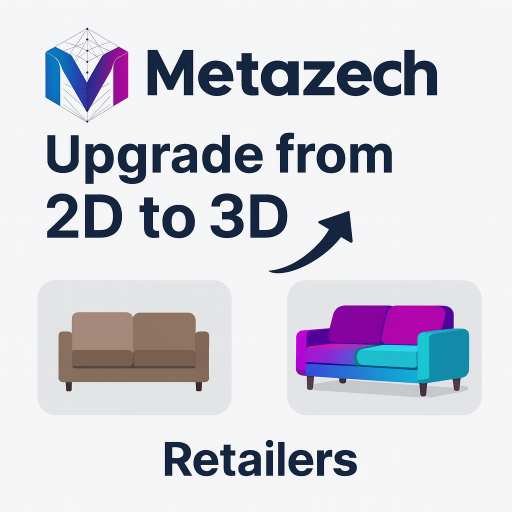
From 2D to 3D: How Retailers Can Upgrade Their Product Listings

Introduction
Traditional 2D product images have long been the foundation of ecommerce. However, as online shopping becomes increasingly experiential, static images alone are no longer enough to meet consumer expectations. Shoppers want to understand scale, depth, texture, and real-world context before committing to a purchase.
This shift is driving retailers across categories to adopt 3D models and augmented reality (AR) as part of their digital product listings. Interactive 3D experiences not only enhance engagement but also help shoppers make more confident decisions.
In this guide, we explore how retailers can successfully transition from 2D to 3D product visualization, supported by industry data and best practices — and how Metaztech.ai enables scalable, AI-driven 3D and AR solutions for ecommerce brands (www.metaztech.ai).
Why 3D Is Becoming Essential in Ecommerce
Retailers adopting 3D and AR technologies are seeing measurable results:
- Higher conversion rates: Web-based AR and interactive 3D experiences have been shown to significantly increase purchase intent and conversions by improving product understanding.
- Lower product returns: When customers can accurately assess size, proportions, and details before purchase, return rates drop — in some cases by up to 40%.
- Improved engagement: Interactive 3D models increase dwell time and page interaction, positively impacting both UX and SEO performance.
Academic and industry research consistently shows that immersive visualization technologies improve consumer trust and decision confidence, especially in digital retail environments.
The Limitations of Traditional 2D Product Images
While 2D images remain useful, they come with clear drawbacks:
- Fixed viewpoints that limit understanding of form and depth
- Difficulty conveying true scale and spatial relationships
- High costs associated with reshoots, variants, and updates
- Limited flexibility for personalization or configuration
As product assortments grow and consumer expectations rise, these limitations become increasingly costly.
What 3D Models Add to Product Listings
Key Advantages of 3D Visualization
3D product models enable retailers to deliver:
- 360-degree exploration: Shoppers can rotate and zoom products freely
- Accurate scale representation: Dimensions are easier to interpret visually
- Material and texture realism: High-fidelity surfaces improve perceived quality
- AR visualization: Customers can view products in real-world environments via their mobile devices
These capabilities create richer product pages while reducing uncertainty during the buying process.
How Metaztech.ai Enables 2D-to-3D Transformation
Transitioning to 3D at scale requires more than just visualization tools — it requires efficient asset creation, optimization, and deployment. Metaztech.ai specializes in AI-powered 3D and AR solutions designed to help retailers modernize their product listings efficiently (www.metaztech.ai).
Metaztech.ai Capabilities
Based on its platform and services, Metaztech.ai supports retailers through:
- AI-assisted 3D model creation: Converting existing 2D images or product data into high-quality 3D assets
- Scalable production workflows: Enabling retailers to digitize large catalogs without excessive time or cost
- Web-optimized 3D delivery: Producing lightweight, fast-loading models suitable for ecommerce websites
- AR-ready outputs: Supporting formats compatible with WebAR and mobile AR experiences
- Seamless ecommerce integration: Allowing interactive 3D viewers and AR features to be embedded directly into product detail pages
This approach allows retailers to future-proof their digital merchandising strategies without disrupting existing workflows.
Why Retailers Are Choosing Partners Like Metaztech.ai
As 3D adoption accelerates, retailers benefit from working with experienced technology partners. Metaztech.ai provides the tools, expertise, and scalability needed to deploy immersive product experiences efficiently — helping brands increase buyer confidence, reduce operational friction, and stay competitive in an evolving ecommerce landscape (www.metaztech.ai).
Conclusion: The Future of Product Listings Is 3D
2D images will always have a place in ecommerce, but the future belongs to interactive, immersive product experiences. By transitioning to 3D models and AR visualization, retailers can elevate customer engagement, reduce returns, and unlock measurable business value. Platforms like Metaztech.ai make this transition achievable at scale — transforming how products are experienced online.