How to Adopt Immersive Product Experiences in Ecommerce—Without Disruption
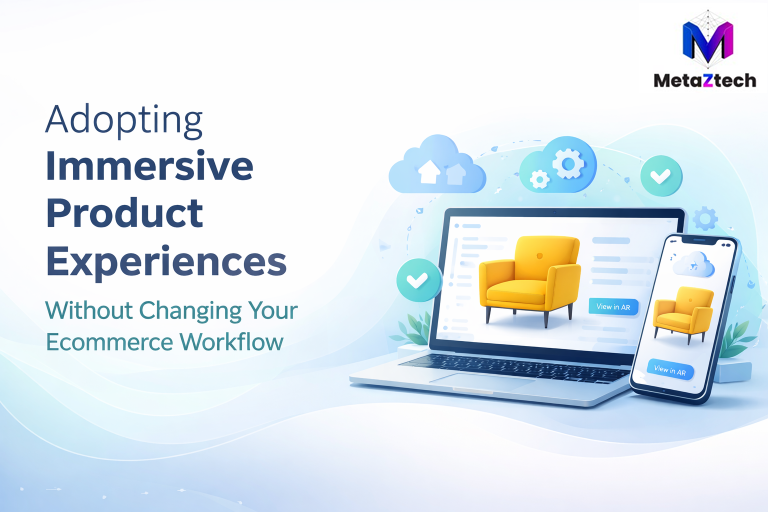

Immersive product experiences like 3D visualization and Augmented Reality (AR) are no longer experimental. They are proven tools for improving customer confidence, engagement, and conversion.
Yet many ecommerce leaders hesitate to adopt them for one simple reason:
“This sounds complex. Will it disrupt my current workflows?”
The good news? It doesn’t have to.
With the right approach—and the right technology partner—immersive product experiences can be rolled out incrementally, practically, and without overhauling your existing ecommerce stack.
Immersive Commerce Is Driving Measurable Business Results
Industry research consistently shows that immersive experiences are delivering real impact across key ecommerce KPIs:
- Higher customer engagement: Shoppers interact longer with products that offer 3D and AR views, increasing time on page and purchase intent.
- Improved customer satisfaction: Buyers report greater confidence when they can explore products interactively or visualize them in real-world contexts.
- Increased retention: Confident first-time buyers are more likely to return, reducing churn.
- Lower return rates: AR and 3D reduce “expectation gaps,” a leading cause of ecommerce returns—especially in categories like furniture, home goods, and apparel.
Multiple retail studies show that immersive product visualization can:
- Increase conversion rates by 20–90%
- Reduce returns by 25–40%
- Drive significantly higher repeat purchase behavior
The challenge is no longer whether immersive experiences work—but how to deploy them without friction.
The Biggest Myth: Immersive Experiences Require Complex Replatforming
Many ecommerce teams assume that adopting 3D and AR means:
- Rebuilding product pages
- Replacing their CMS or ecommerce platform
- Changing inventory management systems
- Adding operational overhead for merchandising and IT teams
That assumption is outdated.
Modern immersive commerce platforms are designed to layer on top of existing systems, not replace them.
A Practical Adoption Model for Immersive Product Experiences
1. Start With Your Existing Product Catalog
You don’t need new SKUs, new workflows, or new product data structures.
Platforms like Metaztech work directly with your existing product catalog, transforming standard product data and images into rich 3D and AR experiences.
This means:
- No changes to how products are created or managed
- No duplication of inventory systems
- No disruption to merchandising workflows
2. Use Cloud-Based Integration—Not Custom Front-End Builds
One of the most practical ways to adopt immersive experiences is through cloud-based delivery and webhooks.
Metaztech offers a cloud-native webhook integration that allows immersive content to be injected into your existing ecommerce flow:
- Product pages remain unchanged structurally
- Inventory management systems stay intact
- No major website rebuilds required
The webhook simply listens to your product events (new product, update, publish) and automatically associates the correct immersive assets—3D viewers, AR experiences, or interactive previews.
From an operations perspective, this feels less like a “new system” and more like a feature enhancement.
3. Roll Out Incrementally—Not All at Once
Practical adoption doesn’t mean flipping a switch across your entire site overnight.
Many ecommerce teams start with:
- High-value or high-return SKUs
- Bestsellers where conversion gains compound fastest
- Categories where visualization matters most (furniture, décor, electronics, configurable products)
Because Metaztech supports full-catalog scalability, teams can start small and expand coverage without re-architecting anything later.
4. Measure What Actually Matters
Immersive experiences are most effective when success is measured beyond traffic:
- Engagement time per product
- Conversion lift vs. static listings
- Return rate changes
- Customer satisfaction and post-purchase confidence
Retailers consistently see that immersive experiences don’t just attract attention—they remove hesitation, which is the real driver of revenue.
Why Immersive Experiences Improve Satisfaction, Retention, and Returns
From a customer’s perspective, immersive experiences solve three core ecommerce pain points:
- Uncertainty
Seeing products in 3D or AR reduces ambiguity around size, scale, materials, and fit. - Mismatch Between Expectation and Reality
AR visualization allows customers to preview products in their own environment—dramatically reducing disappointment. - Decision Fatigue
Interactive exploration helps buyers decide faster and more confidently, improving satisfaction and lowering abandonment.
These benefits translate directly into:
- Happier customers
- Fewer support inquiries
- Lower return logistics costs
- Stronger brand trust over time
Metaztech: Immersive Commerce Without the Complexity
For ecommerce leaders who want results without operational disruption, Metaztech provides a practical path forward.
With cloud-based delivery, webhook integrations, and full-catalog support, Metaztech enables:
- Scalable 3D and AR experiences across your entire product catalog
- Seamless integration into existing ecommerce platforms
- No major changes to your website, CMS, or inventory systems
- Faster time to value without long development cycles
Whether you’re an enterprise retailer or a growing ecommerce brand, Metaztech helps you adopt immersive product experiences the way modern commerce teams need them: fast, flexible, and operationally sane.
Learn more at https://metaztech.ai
Final Takeaway
Immersive product experiences are no longer a future investment—they are a competitive necessity.
The real differentiator today is how easily you can adopt them.
With the right technology and a cloud-first approach, ecommerce teams can improve customer satisfaction, engagement, retention, and return rates—without disrupting what already works.