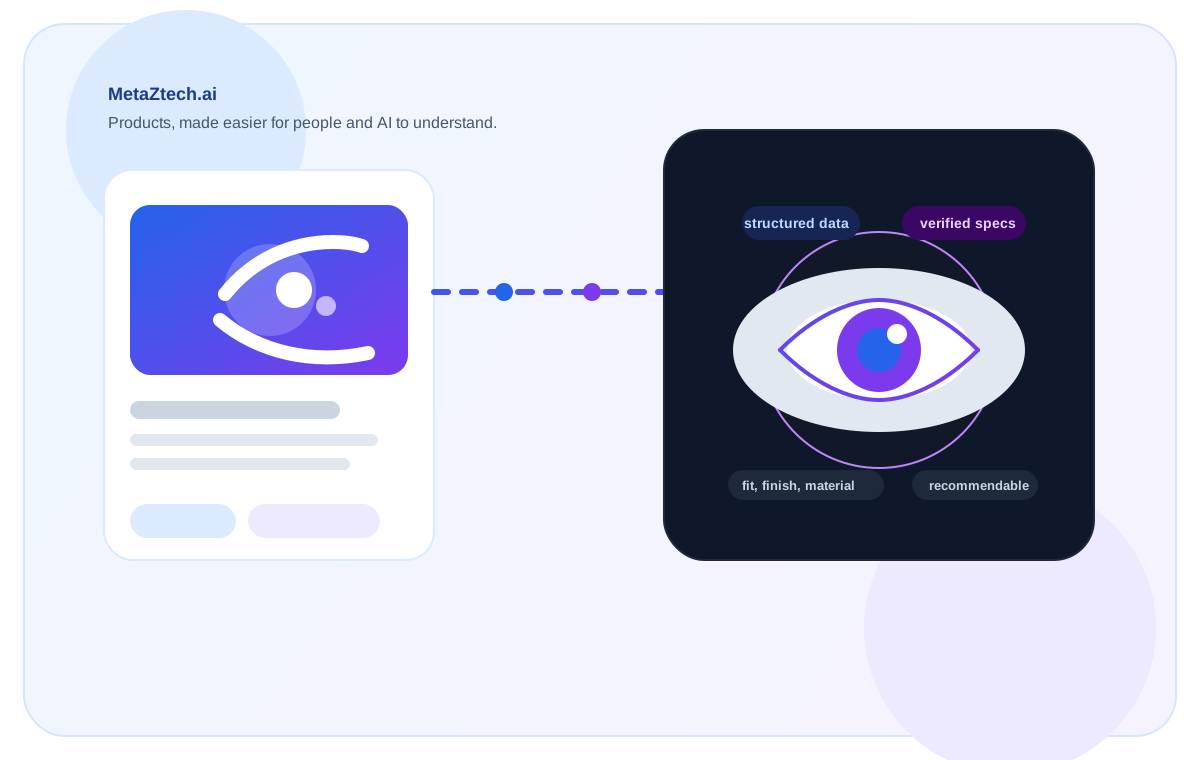
When a shopper asks an AI assistant for "a quiet electric kettle under $80 that ships in two days," the system increasingly does more than search. It can compare products, weigh constraints, and in some cases complete checkout without sending the shopper through a traditional browsing journey.
That changes the discoverability problem for ecommerce brands. The next sale may not come from a human who saw your homepage or watched your hero video. It may come from a software intermediary that only sees what your catalog expresses as structured data.
If your products are not legible to that intermediary, they effectively do not exist in its world.
Quick Definitions
The vocabulary, briefly
AI-assisted shopping is the research behavior consumers already know: using ChatGPT, Gemini, or Perplexity to compare options and make decisions while the human still presses the buy button.
AI agents go further. Given a goal and the right permissions, they can evaluate tradeoffs and execute the purchase on the shopper's behalf.
Agentic commerce is the broader system forming around that behavior: discovery, comparison, and transaction moving fluidly across websites, marketplaces, apps, and other commerce surfaces with AI participating directly in the flow.
Market Shift
This is not speculation - it is a market
Forecasts vary, but the direction is no longer in dispute. Independent analysts are all pointing to the same structural shift: a meaningful slice of commerce will be mediated by AI agents this decade.
$1T
McKinsey projects that U.S. B2C retail alone could see up to $1 trillion in orchestrated revenue from agentic commerce by 2030.
$300-500B
Bain estimates the U.S. agentic commerce market could reach $300-500 billion by 2030, or roughly 15-25% of ecommerce.
$385B
Morgan Stanley Research forecasts agentic shoppers could drive up to $385 billion in spending by 2030.
$15T
Gartner's B2B outlook is even larger, with more than $15 trillion in spending mediated by AI agents by 2028.
Consumer behavior is already moving with the forecasts. Bain reports that a large share of U.S. consumers are already using generative AI for product research and comparison, which means the discovery layer is changing before many catalogs are ready for it.
IBM IBV 2026
What the IBM study reveals about consumer readiness
IBM's Institute for Business Value published one of the clearest large-scale snapshots of the space in January 2026. The report covers more than 18,000 consumers across 23 countries, plus 200 senior executives from large enterprises.
AI adoption is compounding
IBM IBV reports that global consumer use of AI applications grew 62% over the past two years, with Gen X and Boomers posting especially strong growth.
AI is now a discovery channel
The study says 41% of consumers use AI assistants to research products, 33% use them to scan reviews, and 31% use them to search for deals.
Consumers already know what agents should do
Deal hunting, always-on service, review screening, and personal shopping are the top jobs consumers want delegated to AI.
Data is the blocker
Retail leaders see standardized AI integration as strategic, but many still report data integration issues across channels and systems.
"Customers cannot buy what they cannot find."
Shantha Farris, IBM Consulting, cited in IBM IBV's Own the Agentic Commerce Experience
Discoverability
The problem, restated
Search engine optimization taught brands to be legible to humans scanning result pages. Agentic commerce requires being legible to software systems scanning structured product records.
An agent does not appreciate the mood of your product photography. It evaluates whether the product data is complete, trustworthy, comparable, and easy to act on.
What an agent looks for
- Explicit categories, use-cases, and product types that align with common standards.
- Machine-readable dimensions, materials, weights, and other factual specifications.
- Variants such as color, size, finish, or pack count exposed as structured attributes.
- 3D assets that can answer spatial questions such as fit, scale, and material context.
- Certifications, origin, and sustainability claims stored as verifiable data instead of buried in copy.
- Specific and accurate alt text that describes the actual product rather than generic marketing language.
In Practice
What "agent-legible" means for your catalog
Agent-legibility is not one schema field or one feed export. It is a stack of structural choices: a canonical product record, clear attributes, queryable 3D assets, trustworthy certifications, and a distribution strategy that reaches the systems where agents actually operate.
Most catalogs were built for human readers first. Retrofitting them for both humans and AI agents is usually not a one-sprint task. It is a strategic content and data program.
How MetaZtech Helps
Making your catalog machine-readable without losing the human buying experience.
MetaZtech already works at the layer where immersive content and structured product data meet. That is useful for shopper engagement today, and it is becoming equally useful for AI-led discovery and recommendation.
01 / Capture
3D models with product metadata
MetaZtech's 3D workflows can anchor dimensions, materials, and structural attributes directly into the product asset so humans and machines are reading from the same source.
02 / Describe
Schema-aware product pages
The product story stays readable for shoppers while the underlying record stays structured for AI agents, marketplaces, and search systems.
03 / Structure
Faceted attribute taxonomy
Variants, finishes, sizes, and use-cases are stored as structured facets so AI systems can match them to detailed buying prompts.
04 / Verify
Trust and provenance signals
Origin, certifications, dimensional accuracy, and sustainability details can be represented as consistent product data instead of vague claims.
05 / Distribute
Channel-ready product records
Once a clean canonical record exists, it can flow to your site, marketplaces, partner feeds, and the agent-native commerce channels now emerging.
First Steps
Where to start now
Audit five high-velocity SKUs in ChatGPT, Perplexity, and Gemini. Ask for recommendations with detailed constraints and check whether your products surface cleanly.
Choose a canonical product record. Stop letting the website, PIM, DAM, and ERP each tell a slightly different story about the same SKU.
Instrument every important product for two readers: the shopper who wants a persuasive story and the agent that wants structured facts.
The catalogs instrumented in 2026 are likely to compound for the rest of the decade. The ones that stay messy and unstructured may not fail loudly. They may simply become less visible each year.
Want a practical readout?
See what an AI agent sees in your product catalog today.
Send us a product URL and we can help map the gap between your current listing and an agent-ready product record.
Sources
Further reading
- 01IBM Institute for Business Value
Own the Agentic Commerce Experience, January 2026.
- 02McKinsey & Company
The agentic commerce opportunity, October 2025.
- 03Bain & Company
2030 Forecast: How Agentic AI Will Reshape US Retail, 2026.
- 04Morgan Stanley Research
Agentic Commerce Impact Could Reach $385 Billion by 2030, December 2025.
- 05Gartner IT Symposium/Xpo
Strategic predictions for 2026 and beyond, November 2025.